The answer
Sunlight grows with the inverse square of distance, so moving even a little closer would heat Earth a lot; much closer, and the oceans could boil away like Venus's may have.
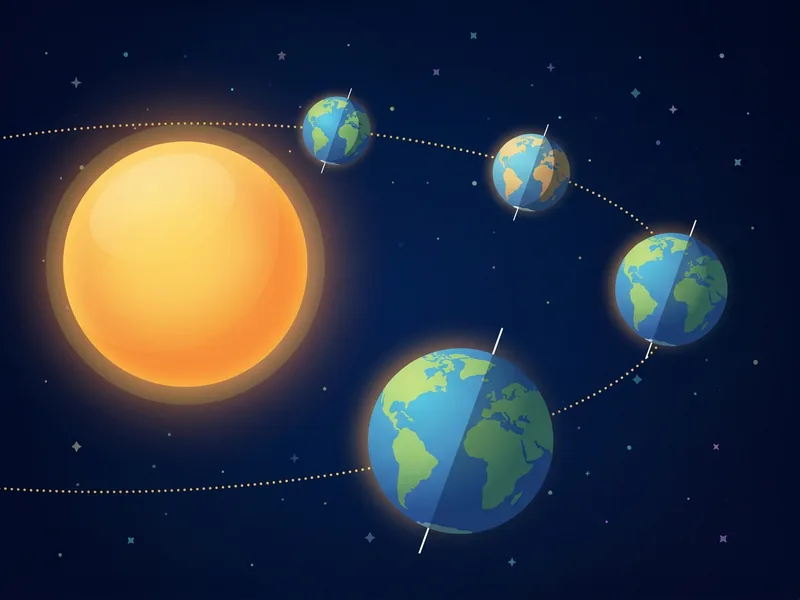
Sunlight spreads out as it travels away from the Sun, like paint sprayed over a bigger and bigger ball. Its strength falls with the square of the distance: twice as far means a quarter of the light, half as far means four times as much.
Closer planets also go around faster. Kepler's laws say a planet's year grows with distance, so a closer Earth would have a shorter year. At Venus's distance, a year would last about 225 days.
Astronomers talk about a habitable zone: the range of distances where a planet like Earth could keep liquid water on its surface. Earth is inside it today. Too close, and more water vapour in the air traps more heat, which evaporates more water, in a runaway loop. Venus may have gone through something like this, and today its surface is about 465 °C.
Exactly where the habitable zone's edges are is uncertain. Some models suggest that moving Earth only a few percent closer to the Sun could start this runaway warming, while others, which include the cooling effect of clouds, put the edge closer in. Too far out, and water would freeze, though a thick atmosphere could help keep a planet warm.
What we know and what we don't
What physics tells us
- Sunlight strength falls with the square of distance.
- A closer orbit means a shorter year (Kepler's third law).
- Venus's surface is about 465 °C under a thick carbon dioxide atmosphere.
Scientists aren't sure
- Exactly how close Earth could get before a runaway greenhouse effect: estimates of the habitable zone's inner edge differ between climate models.
- Whether Venus ever had oceans is still debated.
Go deeper
Why? How hot would Earth be without its atmosphere?
Without the greenhouse effect, Earth's average temperature would be about -18 °C, below freezing. Greenhouse gases like water vapour and carbon dioxide warm it to about 15 °C. Too few greenhouse gases freeze a planet; too many cook it.
Why? Will the Sun get brighter?
Yes. The Sun slowly brightens, about 10% every billion years. In roughly a billion years, it may make Earth too hot for liquid oceans, even without Earth moving at all.
Why? Why is Mercury not the hottest planet?
Mercury is closest to the Sun, but it has almost no atmosphere to hold heat, so its night side drops to about -180 °C. Venus's thick carbon dioxide atmosphere traps so much heat that it's hotter than Mercury day and night.
Keep wondering


Sources
- Habitable Zones Around Main-Sequence Stars: New Estimates (Kopparapu et al.), The Astrophysical Journal, 2013
- Venus: Facts, NASA Science
- Earth Fact Sheet, NASA Goddard (NSSDCA)