The answer
Near a small black hole you'd be stretched like spaghetti before reaching the edge; a giant one would let you cross the edge intact, and what happens after that, no one knows.
Every black hole has an edge called the event horizon. Outside it, light can still get away. Inside it, everything, even light, can only fall inward. The heavier the black hole, the bigger its horizon: about 3 km in radius (6 km across) for each Sun's worth of mass.
Gravity gets stronger the closer you get. If you fall feet first, your feet are closer than your head, so they're pulled harder. That difference stretches you lengthwise and squeezes you from the sides. Scientists really do call this spaghettification.
For a small black hole, about 10 times the Sun's mass, the stretch near the horizon is millions of times stronger than Earth's gravity, so you'd be pulled apart long before you got there. For a supermassive one, like the 4-million-Sun black hole at the centre of our galaxy, the horizon is so far from the centre that you'd cross it without feeling any stretch at all. The stretch would only tear you apart later, deeper inside.
A friend watching from far away would see something strange: as you got close to the horizon, you'd seem to slow down, get redder and dimmer, and fade away, never quite seeming to cross. That comes from Einstein's general relativity. What happens deep inside a black hole, at its centre, is one of the biggest open questions in physics. Scientists aren't sure, because our current theories stop working there.
What we know and what we don't
What physics tells us
- The event horizon's size grows with mass, about 3 km in radius per solar mass.
- Tidal stretching near a small black hole is deadly well outside its horizon; at a supermassive one you could cross the horizon unharmed.
- A distant watcher sees a falling object slow, redden and fade near the horizon.
Scientists aren't sure
- What happens at the centre of a black hole. General relativity predicts a singularity, but scientists expect a theory of quantum gravity, which we don't have yet, to change that picture.
Go deeper
Why? Have we ever seen a black hole?
Yes, in a way. In 2019 the Event Horizon Telescope showed the glowing ring around the shadow of the black hole in the galaxy M87, about 6.5 billion times the Sun's mass. In 2022 it did the same for Sagittarius A*, the one at the centre of our Milky Way.
Why? Would a black hole suck up Earth?
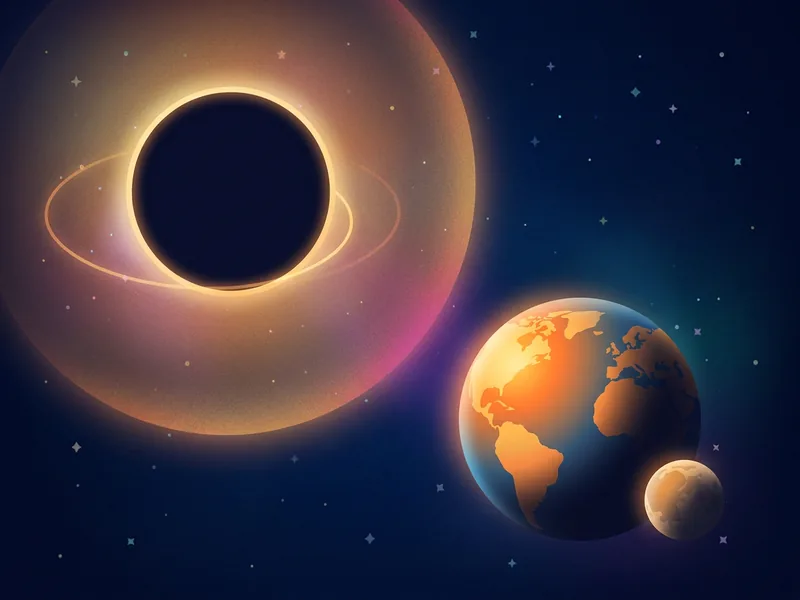
Not unless Earth got very close. From far away, a black hole pulls like any other object of the same mass. If the Sun were replaced by a black hole of the same mass, Earth would keep orbiting just as it does now. It would just get very dark and cold.
Why? Why can't light escape?
Inside the horizon, space itself is falling inward faster than light can travel through it. Light still moves at light speed, but every direction it could go leads further in.
Keep wondering

Sources
- Black Hole Anatomy, NASA Science
- Black Holes, NASA Science
- We got it! Astronomers reveal first image of the black hole at the heart of our galaxy, U.S. National Science Foundation