The answer
For about 8 minutes and 20 seconds nothing would change, because light and gravity both travel at light speed; then the sky would go dark and Earth would fly off in a straight line.
This can't actually happen: the Sun can't just disappear. But it's a great way to see how light and gravity travel.
The Sun is about 150 million km away, and light takes about 8 minutes and 20 seconds to cross that distance. So the sunlight you see is already 8 minutes old. If the Sun vanished, the light already on its way would keep arriving, and the sky would look normal until the last of it got here.
Gravity works the same way. Changes in gravity travel at the speed of light. In 2017, astronomers detected gravitational waves and light from the same crash of two neutron stars, 130 million light years away, arriving within two seconds of each other. So for those 8 minutes and 20 seconds, Earth would keep curving around a Sun that's no longer there.
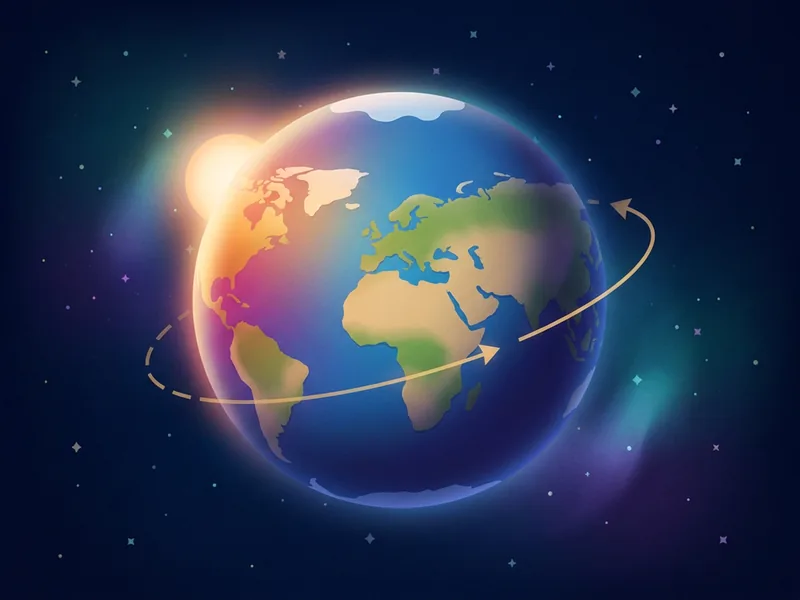
Then the light would stop, and Earth would stop being pulled. It would carry on in a straight line at about 30 km per second, the speed it was already moving along its orbit, heading off into space with the Moon still going around it. The planets farther out would find out later: Jupiter after about 43 minutes.
What we know and what we don't
What physics tells us
- Sunlight takes about 8 minutes and 20 seconds to reach Earth.
- Changes in gravity travel at the speed of light (confirmed by the 2017 neutron star merger).
- Earth would then move in a straight line at about 30 km/s, with the Moon still orbiting it.
Scientists aren't sure
- How fast Earth would cool and how long life could hold on are estimates, not exact predictions.
Go deeper
Why? How long would Earth stay warm?
This part is extrapolation. Without sunlight, the surface would cool quickly, falling well below freezing within weeks. The oceans hold a lot of heat, though, so they'd freeze from the top down over many years, and the ice on top would slow the freezing below. Heat from inside Earth would keep the deep ocean and the rock underground warm for a very long time.
Why? Could anything survive?
Scientists think some life could, for a while. Microbes living deep underground, and animals around hot vents on the sea floor, get their energy from Earth's chemistry and heat, not from sunlight.
Why? Would we still see the planets?
Planets only shine by reflecting sunlight. Each would go dark after the last sunlight reached it and the light it reflected travelled back to us. The stars would still shine, brighter than ever against a truly dark sky.
Keep wondering
Sources
- Earth Fact Sheet, NASA Goddard (NSSDCA)
- GW170817 Press Release, LIGO Caltech