The answer
Freezing locks water molecules into an open hexagonal pattern, so ice takes up more room than the same water as a liquid and is less dense.
Something floats when it is less dense than the liquid around it: less mass packed into the same space.
In liquid water, molecules tumble around and slide past each other, packed fairly close. Each one is a bit like a tiny boomerang with slightly charged ends, and those ends attract each other. This pull is called a hydrogen bond.
When water freezes, the hydrogen bonds lock every molecule into place in a hexagonal pattern, like a honeycomb. That pattern holds the molecules a little farther apart than they are in the liquid, with open space in the middle of each ring.
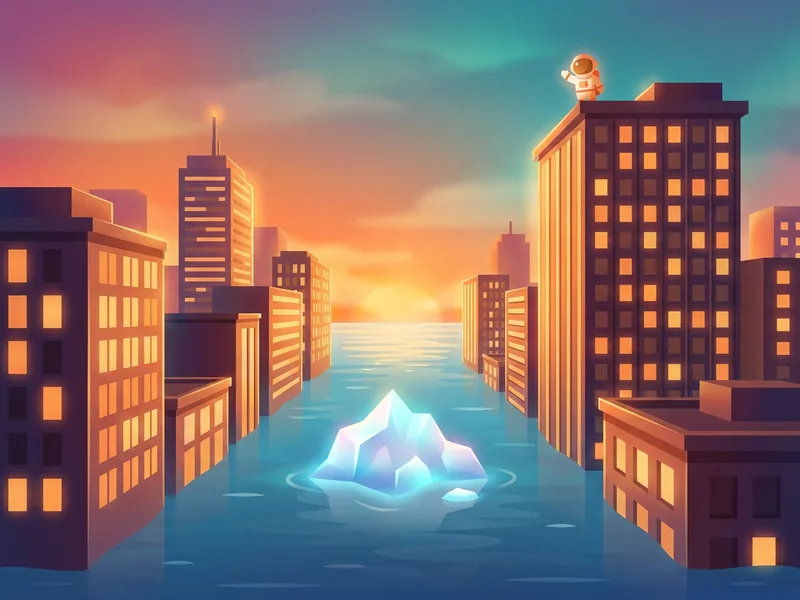
So ice is about 0.92 grams per cubic centimetre, while liquid water is about 1.00. Because of that, about nine tenths of a floating piece of ice sits under the surface, and one tenth sticks out. That is where the saying 'the tip of the iceberg' comes from.
Go deeper
Why? Why don't lakes freeze solid in winter?
Liquid water is densest at about 4 °C. As a lake cools in fall, the 4 °C water sinks to the bottom and colder water stays on top, where it freezes. The floating ice then acts like a lid that slows further freezing, so fish can survive below.
Why? Why do frozen pipes burst?
Water expands by about 9% when it freezes. In a closed pipe there is nowhere for that extra volume to go, so the pressure can split the pipe.
Why? Is water the only thing that does this?
No, but it is rare. Silicon, gallium, germanium and bismuth also expand when they freeze. For almost every other substance, the solid sinks in its own liquid.
Keep wondering

Sources
- Water Density, USGS Water Science School
- Ninety percent of an iceberg is below the waterline, USGS