The answer
There would be almost no seasons: the noon Sun would sit at the same height all year and every day would be about 12 hours long.
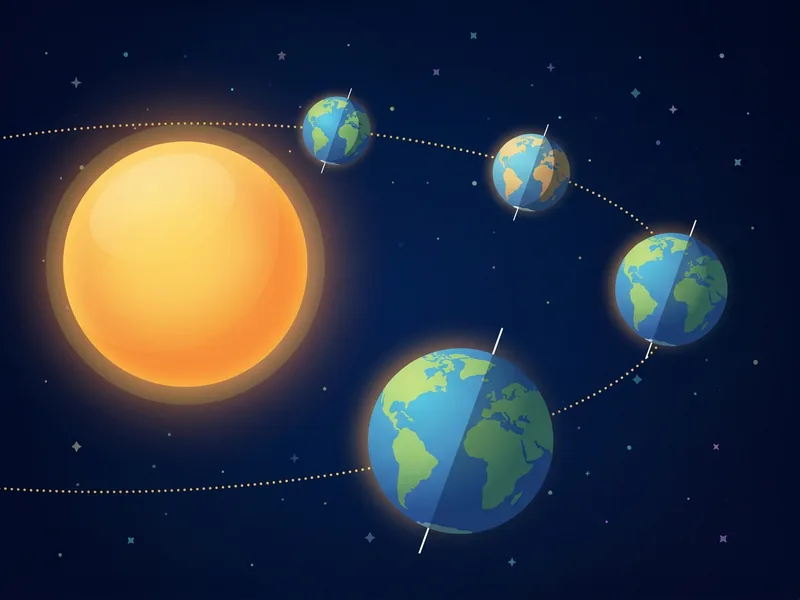
Seasons come from the tilt. As Earth goes around the Sun, the tilt makes each hemisphere lean toward the Sun for half the year (higher Sun, longer days, summer) and away for the other half (winter).
With no tilt, the Sun would always be straight over the equator at noon. Wherever you live, the noon Sun would be just as high in June as in December, and days would always be about 12 hours long.
There would still be a tiny seasonal change, because Earth's orbit isn't a perfect circle: we get about 7% more sunlight in early January, when we're closest to the Sun, than in early July. But that's much weaker than what tilt does today.
The weather would still change from day to day, but each place would stay in about the same season all year. Near the poles, the Sun would always skim the horizon, so they'd likely be even colder than now. Scientists aren't sure exactly how climates would settle, because ice, oceans and winds all respond together.
What we know and what we don't
What physics tells us
- With zero tilt, the noon Sun would stay at the same height all year, and days would be about 12 hours everywhere except near the poles.
- A small seasonal change would remain from Earth's slightly oval orbit (about 7% more sunlight in January than July).
Scientists aren't sure
- How climates, ice and winds would settle in the long run.
Go deeper
Why? Do other planets have different tilts?
Yes. Mars is tilted about 25 degrees, close to Earth, so it has seasons too. Jupiter is tilted only about 3 degrees, so it barely has any. Uranus is tilted about 98 degrees, lying on its side, so each pole gets 42 years of daylight followed by 42 years of night.
Why? Does Earth's tilt ever change?
A little. It slowly rocks between about 22.1 and 24.5 degrees over a cycle of about 41,000 years. Those small changes, along with others in Earth's orbit, help set the timing of ice ages.
Why? Would the tropics and the Arctic Circle still exist?
Not really. The Tropics of Cancer and Capricorn mark how far north and south the Sun can be overhead, and the Arctic and Antarctic Circles mark where there's a day with no sunset. With zero tilt, they'd all collapse onto the equator and the poles.
Keep wondering

Sources
- What Causes the Seasons?, NASA Space Place
- Milankovitch (Orbital) Cycles and Their Role in Earth's Climate, NASA Science